TDM Remote Viewing: A Detailed Guide to Trans-Dimensional Mapping
Remote viewing has expanded over the decades into many styles and methodologies, but few are as visually rich and multi-layered as TDM — Trans-Dimensional Mapping. Unlike traditional RV sessions that focus on single-target descriptions, TDM allows the viewer to explore relationships, influences, energies, timelines, events, and people all within one structured map.
This approach is ideal for advanced practitioners who want to build a deeper understanding of how a target functions across layers of reality, time, and perspective.
What Is TDM Remote Viewing?
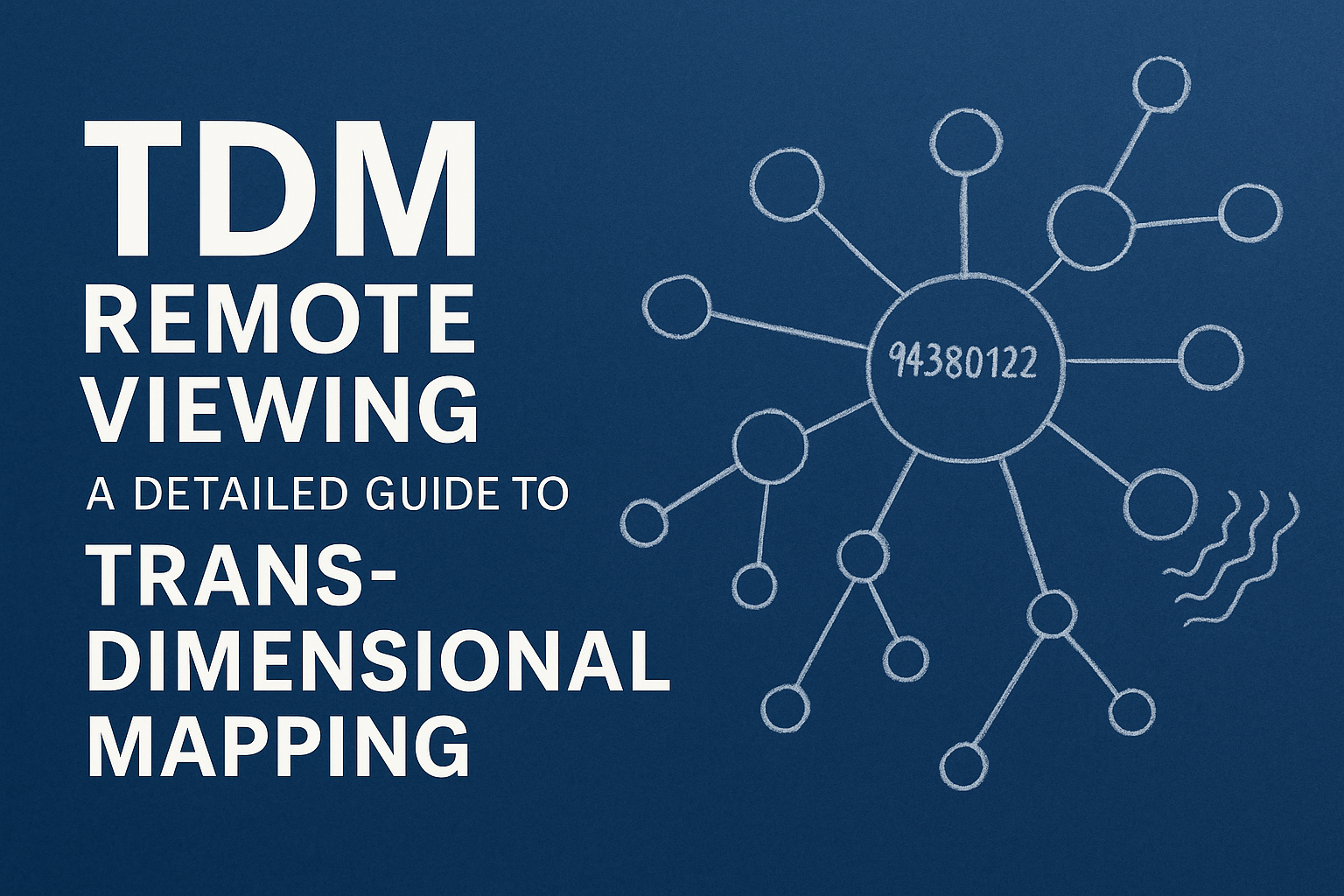
Trans-Dimensional Mapping (TDM) is a remote viewing technique where the viewer creates a large, interconnected map instead of linear session notes. Each element—whether a person, place, event, object, or energy—is represented as a node, and the viewer draws lines, arrows, patterns, or symbolic indicators that reflect how those nodes interact.
TDM transforms intuitive perceptions into a visual, structured diagram that reveals:
- Relationships
- Influences
- Causes & effects
- Emotional signatures
- Energetic flow
- Hidden dynamics
- Parallel or overlapping timelines
- Information across non-physical levels
This makes TDM especially useful for complex targets that cannot be captured by a single sketch or sensory list.
Why TDM Is Different From CRV or ERV
CRV
Focuses on controlled stages → S1 to S6
Emphasis on sensory descriptors and sketching
ERV
Relaxed, quiet state
Open, symbolic, free-flowing impressions
TDM
Structured like CRV, intuitive like ERV
But the output is a map, not a transcript
TDM is ideal for:
- Multi-layered targets
- Events involving multiple people
- Consciousness targets
- Energetic or symbolic subjects
- Historical events
- Future probability exploration
- Contact encounters
- Mystical or anomalous phenomena
How a TDM Session Begins
1. Assign a blind 8-digit target ID
Just like any RV session, TDM begins blind.
Example:
94380122
2. Enter your preferred RV state
CRV-style relaxation or ERV-style quiet mind both work.
3. Create a large workspace
TDM usually needs:
- An 18×24 inch sheet
- A whiteboard
- A digital canvas
- A mapping pad
The map will grow outward as you explore.
4. Place the central target node
Write the target ID in a circle in the center.
This is your “anchor point.”
Building the Map
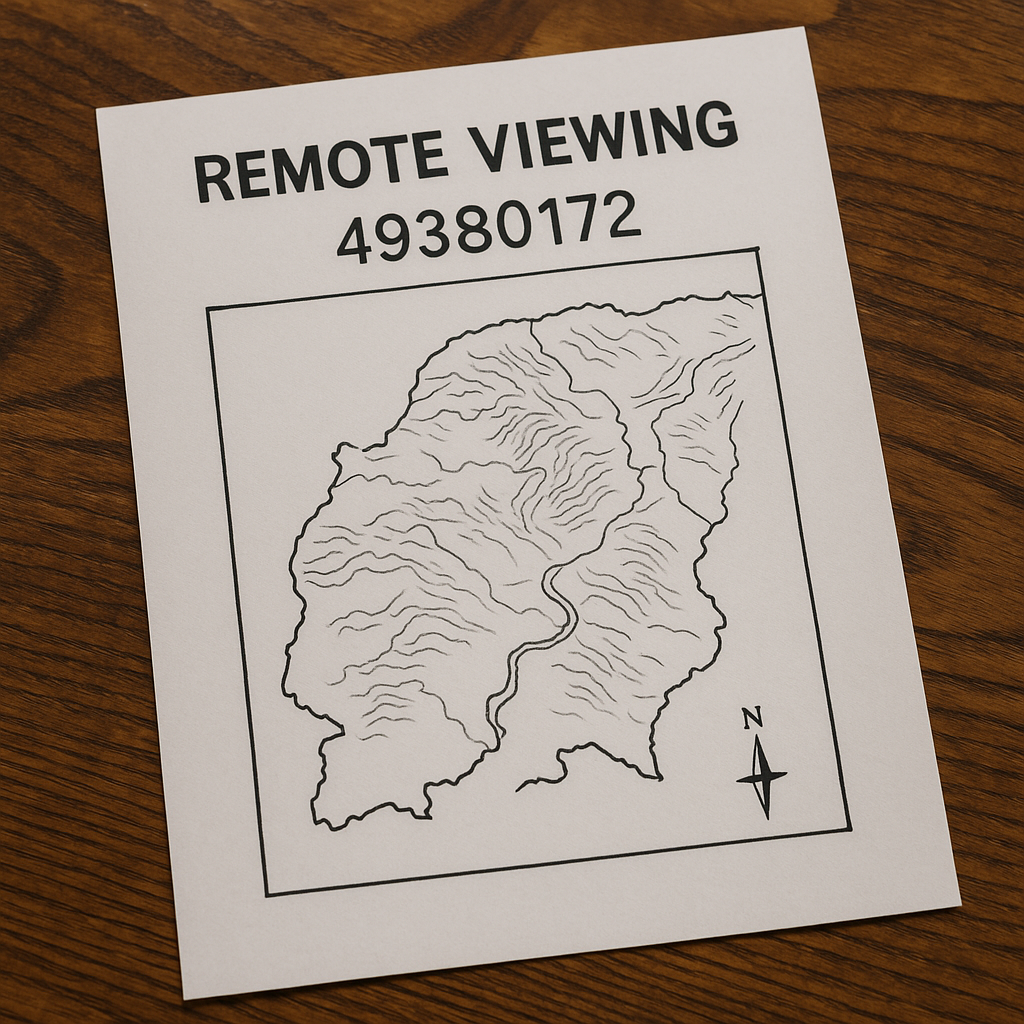
During the session, impressions appear as:
🔸 Nodes
Circles that represent people, places, energies, objects, emotions, or events.
🔸 Lines / Arrows
Connections, movement, influence, or directionality.
🔸 Symbols
Energetic signatures, emotional tone, cause/effect, or non-physical qualities.
🔸 Timelines
Horizontal or angled lines that represent time, with nodes placed along them.
🔸 Layers
Stacked circles or overlapping zones that represent dimensional or perceptual layers.
🔸 Energetic Structures
Waves, spirals, radiation lines, compression zones, etc.
Each TDM map becomes a unique blueprint of the target’s deeper dynamics.
Interpreting a TDM Map
When the map is finished, the viewer examines:
✔ Areas of density
Where multiple lines converge
→ Indicates importance or central influence
✔ Directional arrows
→ Show force or movement
✔ Symbolic clusters
→ Represent emotional, energetic, or consciousness patterns
✔ Disconnected nodes
→ May indicate hidden or missing pieces
✔ Timeline intersections
→ Reveal when events influence each other
✔ Hierarchies
→ Which nodes dominate or direct the structure
The map becomes a visual “story” of how the target functions across dimensions of reality.
Common Uses of TDM
🔹 Contact encounters
Mapping beings, craft, events, emotional signatures, motivations
🔹 Historical events
Showing how groups, forces, and influences interacted
🔹 Psychic or anomalous experiences
Revealing layers of perception and non-physical communication
🔹 Healing or emotional targets
Identifying patterns, blockages, or energetic flow
🔹 Strategic exploration
Understanding multi-variable situations with many players
🔹 Consciousness studies
Perceiving structures beyond the physical layer
Example Structure of a TDM Map
Center node: Target ID
→ Connected to:
- Emotional signature
- Primary event
- Energetic presence
- Key individuals
- Timeline markers
- Influential forces
- Hidden or unknown components
- Probability lines
- Future/past echoes
- Non-physical layers
A single TDM session can reveal:
💠 relationships
💠 perspectives
💠 hidden information
💠 origin points
💠 outcomes
💠 multi-dimensional interactions
How to Practice TDM
Step 1: Start with basic RV training
TDM works best once you understand the fundamentals of RV perception.
Step 2: Practice with simple targets
Try mapping:
- Two people interacting
- A historical event
- A place with multiple elements
- A simple emotional environment
Step 3: Expand your map outward
Let intuition guide which nodes appear next.
Step 4: Train regularly
Even 15–20 minutes per day builds strong pattern recognition.
Step 5: Analyze your maps
Study your layouts for recurring shapes, symbols, or patterns.
Why TDM Works
TDM appeals to both hemispheres of the brain:
- Left brain: structure, analysis, mapping
- Right brain: intuition, imagery, feeling
By combining both, TDM can access intricate information that linear RV sometimes misses.
It is not about artistic skill — it is about perceptual structure.
Conclusion
TDM Remote Viewing is one of the most dynamic and multifaceted methods available today. It empowers viewers to move beyond simple sensory descriptions and into the deeper architecture of consciousness, relationship networks, and energetic structures.
Whether you’re mapping a historical event, decoding a dream, analyzing a complex situation, or exploring a contact scenario, TDM offers a profound way to visualize intuitive perception.
⭐ TDM-Relevant Remote Viewing Research & Archives
📁 CIA Stargate Archives (Declassified RV Data)
https://www.cia.gov/readingroom/collection/stargate
📄 CIA Controlled Remote Viewing Manual
https://www.cia.gov/readingroom/document/cia-rdp96-00789r003900020001-4
📄 “Coordinate Remote Viewing” – U.S. Army CRV Manual
https://www.irva.org/library/hamilton/CourseInControlledRemoteViewing.pdf